Gravity Rush Remastered: I Started Playing Because of Control Resonant and LOVED It!
"Brace yourselves, this game is wonderfully unhinged: Gravity Rush walked (or rather, fell freely) in 2012 so that Control Resonant could run on walls today."
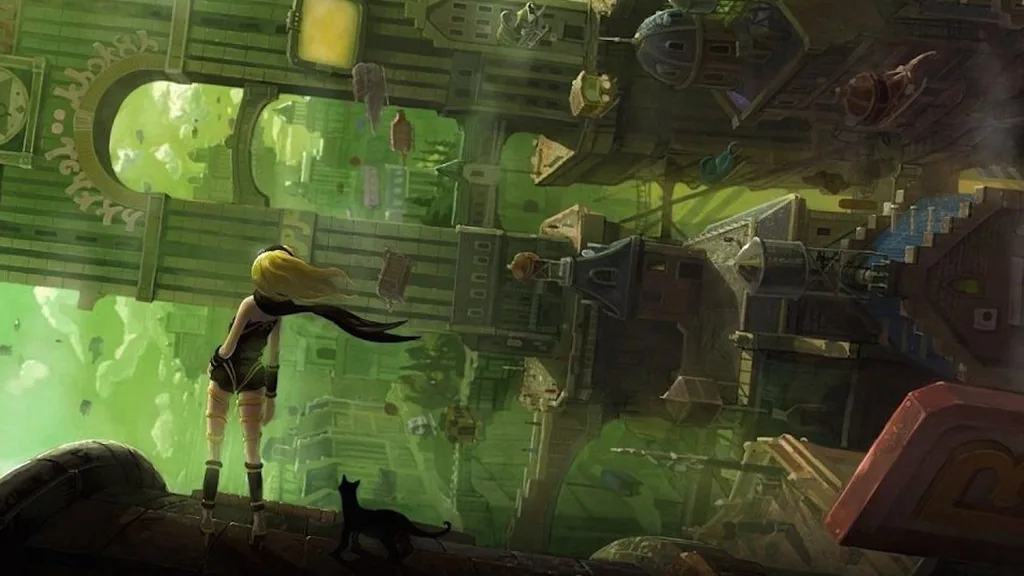
TL;DR // Veredito Rápido
- ▸ Unshackled creativity: Gravity Rush walked (or rather, entered freefall) in 2012 so games like Control Resonant could run across ceilings today.
- ▸ Peerless mobility: The directed freefall mechanic turns exploring Hekseville into one of the most dizzying and exhilarating traversal experiences in gaming.
- ▸ Comic Book Storytelling: Cutscenes told through interactive comic book panels with 3D depth effects bursting with charm and personality.
- ▸ Surgical 60 FPS upgrade: Bluepoint Games' PS4 remaster eliminated handheld motion sickness, giving the game the crisp speed and precision it always deserved.
- ▸ Frustrating and repetitive combat: Ground attacks are ineffective, forcing you into the Gravity Kick—which frequently misses in empty space as the camera spins out.
- ▸ Severe lack of enemy variety: Almost all Nevi are variations of the same amorphous black blob with red weak points in annoying spots.
- ▸ Disorienting camera in tight vertical spots: In chaotic aerial skirmishes, you'll fight harder to figure out where the floor and ceiling are than against the monsters themselves.
- ▸ Handheld legacy open world: Hekseville boasts striking architecture, but pedestrians are lifeless mannequins and the world offers little organic interactivity.
Brace yourselves, because this game is delightfully unhinged. Seriously.
I watched several videos about Control Resonant and was overwhelmed with an itch to play it—which unfortunately will have to wait until next year. One clip in particular caught my eye: Dylan Faden casually running along walls, being pulled by gravitational forces.
That instantly unlocked a long-dormant memory of Gravity Rush, which I had known from old videos. And since it is readily available on the PlayStation Plus Extra catalog, I decided to give the Remastered version a spin.
I am so glad I did.
The original game launched back in 2012 for the late PlayStation Vita made by Sony, conceived and directed by Keiichiro Toyama (the genius behind Silent Hill and Siren). Meanwhile, the Remastered edition we have on PS4 and PS5 was ported in 2015 by the incredible and late Bluepoint Games, the studio responsible for the monumental remakes of Shadow of the Colossus and Demon’s Souls.
And speaking of technical upgrades: jumping from 30 to 60 FPS felt completely essential. On the PS Vita, attempting to push this frenetic game at an unstable 30 FPS—while physically tilting the handheld console around with gyroscope aiming as your horizon flipped upside down—must have caused serious motion sickness and vertigo. Bluepoint delivered rock-solid 60 FPS, remapped gravity steering cleanly to the DualShock/DualSense right analog stick, and gave the game the razor-sharp fluidity a title built around 90% freefall desperately required.
Synopsis
Our journey begins with Kat waking up with complete amnesia in a forgotten alleyway of the floating, vertical metropolis of Hekseville. Beside her appears Dusty, a mysterious feline glowing with cosmic stardust who grants her an extraordinary gift: the power to nullify and redirect gravity around her own body.
Initially met with fear and suspicion by the locals—who call people who do this “shifters”—Kat never holds a grudge. Living as an upbeat squatter in the city’s sewer tunnels, she chooses to use her abilities to help the townsfolk with infectious charm.
 (Kat dealing with the suspicion and wariness of Hekseville authorities)
The city, however, is in crisis: Hekseville is being torn apart by Gravity Storms that swallowed entire municipal districts into the void. To make matters worse, dark-matter monsters called Nevi emerge from the rifts to terrorize civilians. Kat sets out to recover lost neighborhoods, duel with rival shifter Raven, and uncover who she truly is.
Traversal: The Heart Where the Game Truly Shines
This is where the game truly shines!
Kat does not fly like a traditional superhero: she manipulates gravity and hurls herself in a straight line wherever she wants.
Pressing R1 defies physics: Kat lifts off the ground and floats weightless in zero gravity. The world around you keeps moving in real time, while you rotate the camera with the right stick and aim a crosshair at any spot in the environment—a skyscraper roof, a tilted wall, the underside of a train bridge, or open air. Tapping R1 again snaps gravity in that vector, and Kat plunges at terminal velocity toward the target.
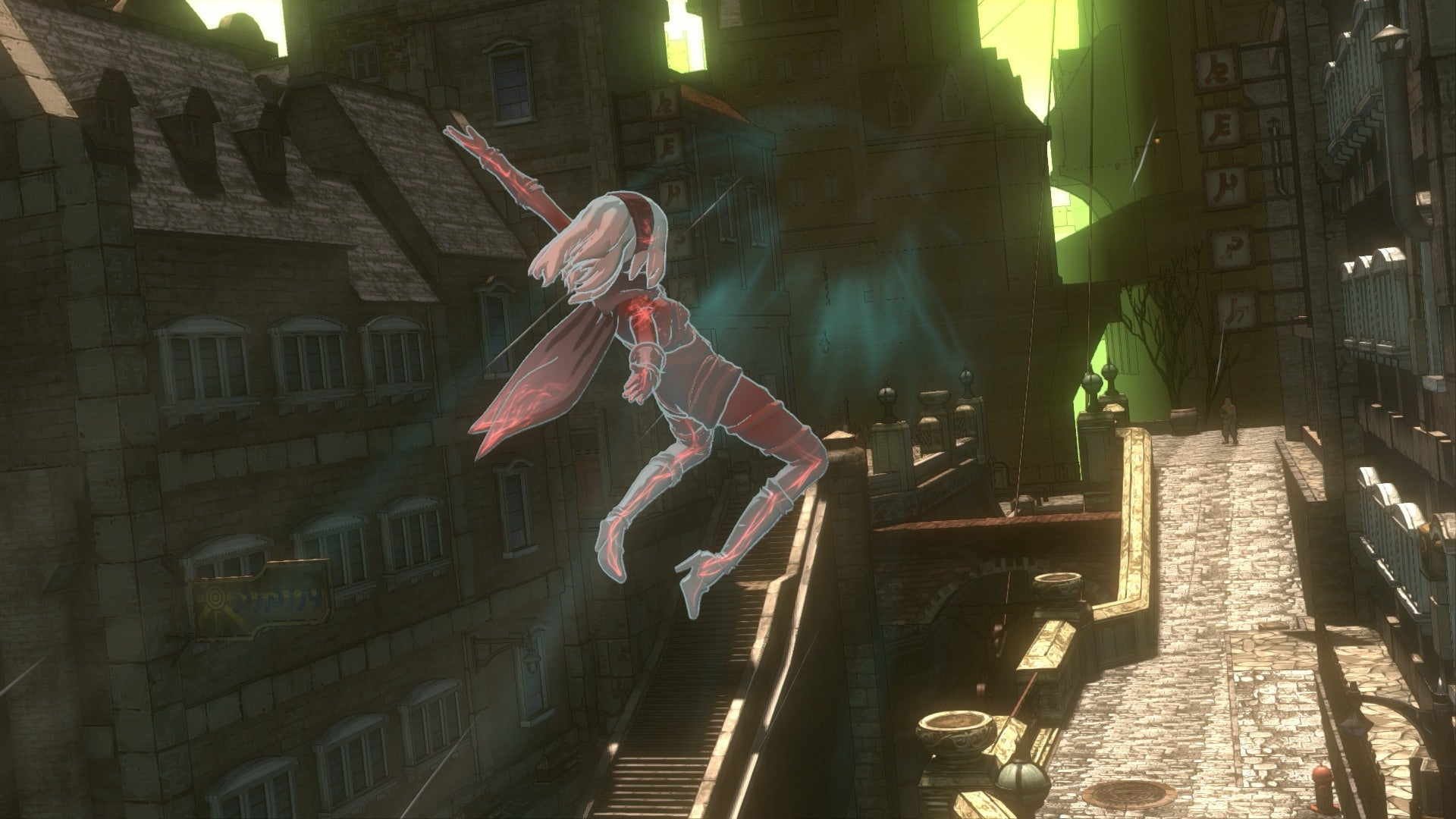 (Pressing R1: Kat weightless in zero-g, ready to launch in any vector)
When she hits the surface, that plane instantly becomes her new floor: Newton’s laws reset, Kat’s hair and clothes drape toward the wall, and you can sprint across vertical facades or run upside down. Want to change course mid-dive? Hit R1 in mid-air to float, aim somewhere else, and dive again!
Additionally, holding both triggers activates the Gravity Slide, turning Hekseville’s streets and elevated rails into an urban skatepark, carving corners and surfing downhill slopes at high speeds.
All this acrobatics lasts as long as you have power in your gravity gauge. As the gauge depletes, that wonderful rush of panic kicks in: you frantically scramble to find a ledge, flagpole, or balcony before physics normalizes and you plummet thousands of meters into the bottomless abyss beneath the city.
Combat: Where the Game Stumbles
If traversal is brilliant, combat is where the game exacts its toll and stumbles.
You have basic ground kicks, but come on: with the freedom to soar across the sky, you’ll naturally want to take flight and unleash gravity-charged dropkicks! The problem is that the camera doesn’t always cooperate (it can even cause dizziness); far too often you fight the camera harder than the monsters themselves.
Your bread-and-butter move is the Gravity Kick: you aim from afar, dive in, and streak like a missile at the enemy’s weak spot. But picture the sequence:
- You line up the crosshair on the weak point;
- You launch at top speed;
- The monster takes half a step to the side;
- You whiff cleanly into empty space;
- The camera whips 360 degrees, you lose all bearing of up and down, and you have to reorient from scratch.
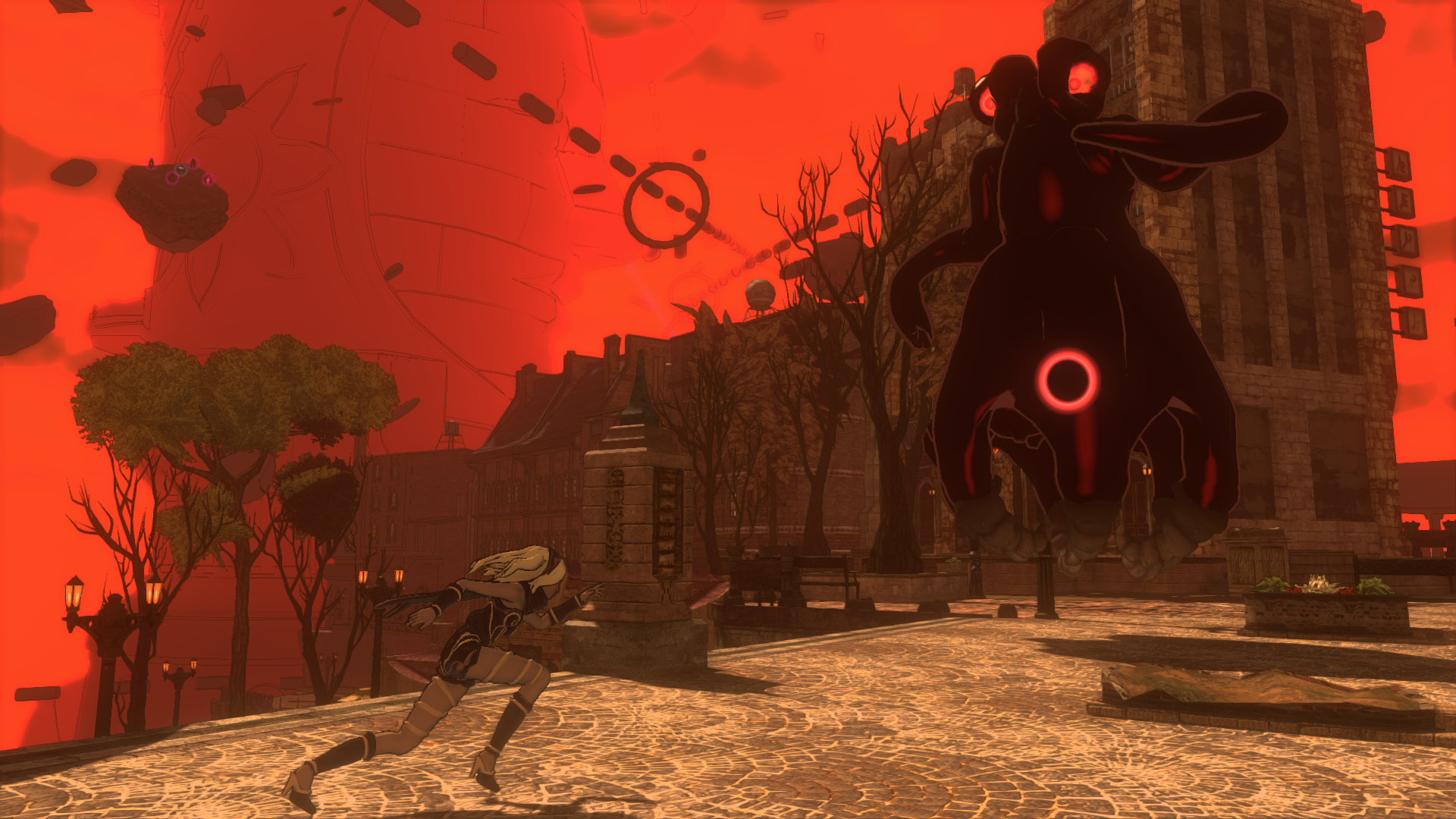 (Dueling a giant Nevi: ground combat is negligible and the Gravity Kick requires camera wrestling)
And speaking of enemies, variety is dismal. You fight essentially the same monster repeatedly, merely with slight variations in shape and abilities. All of them have red spheres as weak points. Trying to hit those cores while juggling multiple foes of varying sizes with awkward weak spots, all while dodging attacks and wrestling with the camera, wears you down fast.
Art Direction: Dated Today, but Incredible for Its Time
Presenting the narrative in comic book (HQ) format is the absolute peak of the art.
The illustrations are gorgeous! Clean, expressive, vibrant, and smoothly paced. You flip through panels using the analog stick or by tilting the controller, treated to a delightful layered 3D depth effect that gives the game a distinct character few modern titles replicate.
 (Interactive comic panels: expressive hand-drawn art, dynamic text bubbles, and 3D depth)
As for the 3D game models, don’t expect lavish detail. The city is decently sized and the architecture is intriguing, but outside of key story NPCs, the street pedestrians are generic mannequins.
The color palettes for districts also lean heavily toward muted browns and grays. And when the game decides to branch out, such as in Gravity Storms, the colors swing to harsh, oversaturated, neon tones that can irritate the eyes.
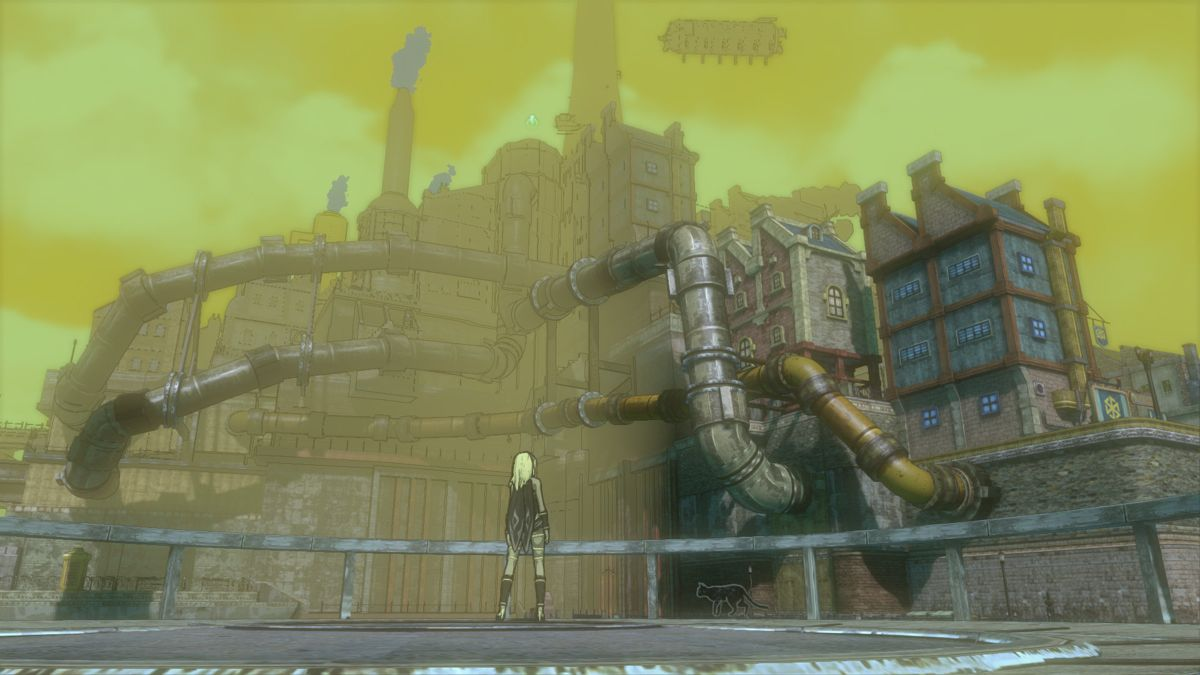 (Hekseville’s industrial architecture, dominated by ochre and gray hues)
On the other hand, the audio is a massive plus: the jazzy, brassy orchestral soundtrack is a delight and perfectly matches Kat’s sense of lighthearted adventure.
Verdict
Gravity Rush Remastered walked in 2012 so gravity-bending games could run today. It has obvious warts in its combat, camera, and enemy repetition—direct artifacts of the humble PS Vita hardware it came from.
Yet the sheer thrill of hurling yourself into the abyss, flipping the world upside down, and sprinting across floating walls remains completely addictive. If Control Resonant can take this core traversal spark and marry it with Remedy’s combat finesse, we’re in for something legendary. Until then, Gravity Rush Remastered remains a must-play for anyone on PS Plus Extra seeking a genuinely inventive, boundary-pushing experience.
Gravity Rush Remastered
Esta pontuação foi gerada através do posicionamento relativo de Gravity Rush Remastered nas 5 Tierlists mestras (Gameplay, Narrativa, Arte, Áudio e Game Feel). Clique na nota acima para inspecionar os pesos e detalhes de cada critério.
Did you appreciate this critical essay? Leave your endorsement: